
The Svadhisthana Chakra, or the sacral chakra, is an energy center located in the lower abdomen that is responsible for creativity, emotions, sensuality, and the ability to enjoy life. As the "dwelling place of the Self," it shapes our emotional identity, governing the flow of life force like water. In this article, we will examine in detail the meaning of the Svadhisthana chakra, signs of its imbalance, and effective practices for harmonization.
What is the Svadhisthana Chakra: Location, Symbols, and Characteristics
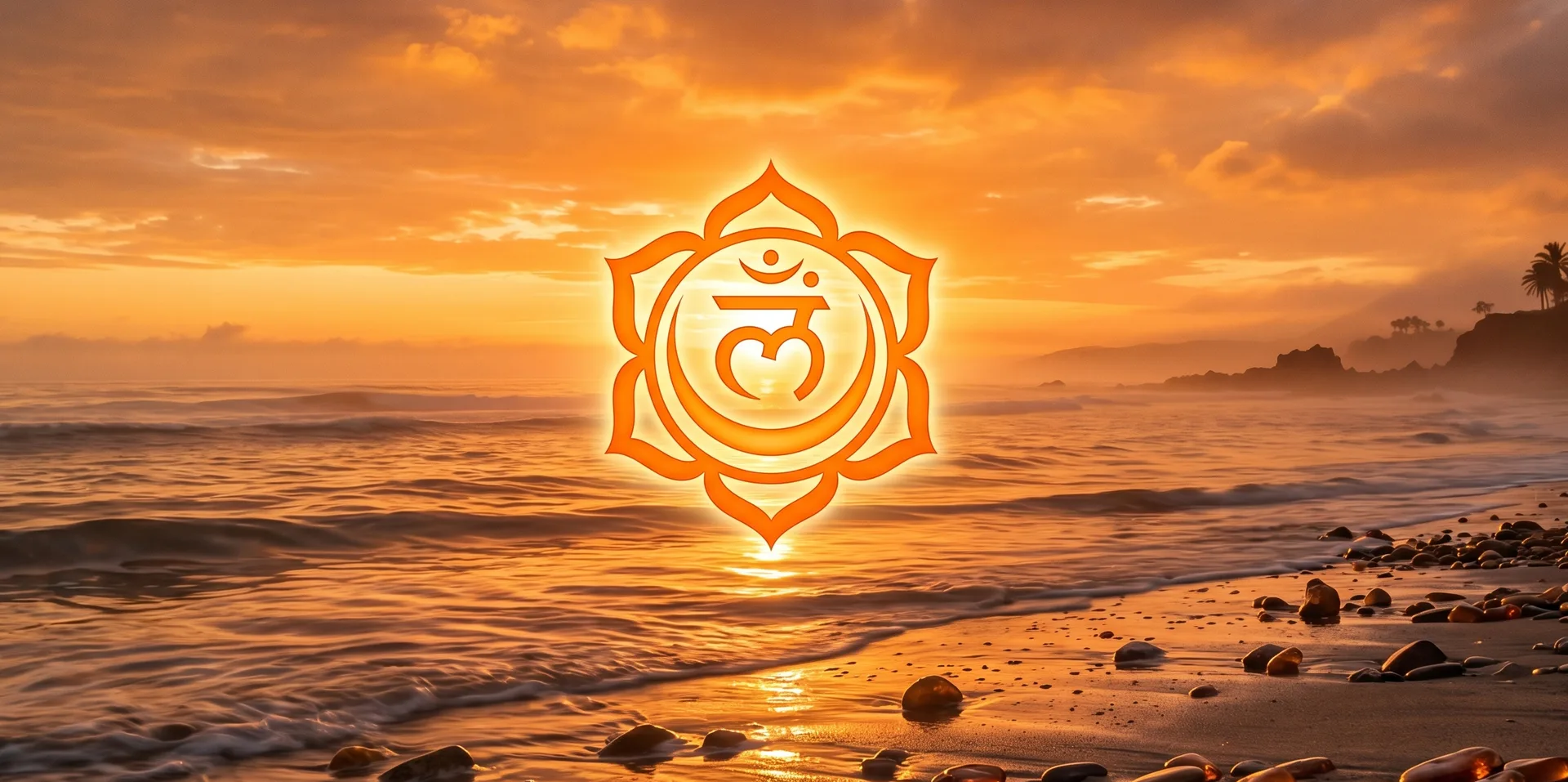
Svadhisthana (Sanskrit: Svādhiṣṭhāna) translates as "one's own dwelling place" or "abode of life force." This chakra is located approximately 4-5 cm below the navel, in the sacral and pelvic region, influencing the urogenital system, kidneys, and reproductive organs. Its color is orange in all shades, symbolizing warmth and creative energy, and its element is water (apas), reflecting flexibility and emotional fluidity. Symbolically, the Svadhisthana chakra is depicted as a lotus with six petals, with a yantra in the shape of a crescent moon and the bija mantra VAM at its center. Its ruling planet is Jupiter, which promotes expansion and emotional growth.
Посмотрите свой чакроанализ
Введите дату рождения — карта семи чакр за 30 секунд
What the Sacral Chakra Governs: Creativity, Emotions, and Sensuality
The sacral chakra is the center of emotional intelligence, creative self-expression, and healthy sexuality. It forms during adolescence (ages 7-14), when self-identification and sensuality awaken. Key functions include:
- Creativity and Inspiration: The Svadhisthana chakra nourishes artistic talents, innovative ideas, and the capacity for self-expression.
- Emotional Intelligence: Governs empathy, the ability to feel others, and adaptability to emotional currents.
- Sensuality and Pleasure: Responsible for healthy sexuality, intimacy, and the ability to enjoy life without guilt.
- Relationships and Charisma: Influences attractiveness, the capacity for deep connections, and spontaneity in communication.
Signs of a Balanced Svadhisthana Chakra
When the sacral chakra is harmonious, a person experiences lightness and fullness of life. Here are 10 key signs:
- The ability to experience joy and pleasure without internal prohibitions.
- Healthy sexuality and a harmonious intimate life.
- Emotional flexibility — the ability to flow with feelings, like water.
- Active creative self-expression and constant inspiration.
- Deep empathy and understanding of others' emotions.
- The ability to build deep relationships without manipulation or dependency.
- Spontaneity and the freedom to be oneself in any situation.
- Natural attractiveness and charisma, felt on physical and energetic levels.
- Optimism and charm, ease in communication.
- A high level of energy for realizing creative projects.
Signs of a Blocked Svadhisthana Chakra
Imbalance in the Svadhisthana chakra manifests on three levels: psychological, physical, and behavioral.
Psychological Symptoms
Emotional coldness, inability to experience pleasure, constant guilt over one's desires, suppressed emotions, depressive states, loss of creative inspiration, indifference to life, egocentrism, and difficulties in forming emotional bonds.
Physical Manifestations
Problems with the urogenital system (impotence, frigidity), hormonal imbalances, infertility, menstrual cycle disorders, prostatitis, chronic lower back pain, kidney diseases, constant fatigue, and reduced vitality.
Behavioral Signs
Emotional numbness, avoidance of closeness and intimate relationships, conscious refusal of pleasures, asceticism out of fear, loss of interest in hobbies and creative pursuits.
Signs of an Overactive Svadhisthana
An excess of energy in the sacral chakra manifests as emotional instability, hysteria, sexual obsession, hedonism, a tendency toward addictions (to food, sex, entertainment), emotional manipulation, excessive drama, aggressive outbursts, egocentrism, and a lack of genuine empathy for others.
Causes of Sacral Chakra Imbalance
A blocked Svadhisthana chakra often forms in childhood and adolescence. The main causes are:
- Sexual trauma and abuse, leading to suppressed energy.
- Suppressed emotions in childhood, especially during the critical period of ages 7-14.
- Religious or strict upbringing with taboos on pleasure and sensuality.
- Prohibition of creative expression and self-expression.
- Chronic stress and emotional burnout, overloading the chakra.
- Social stereotypes that condemn the free expression of emotions.
Opening the Svadhisthana Chakra: 12+ Practices for Harmonization
Harmonizing the Svadhisthana chakra requires regular practices aimed at activating creative energy and emotional fluidity. It is recommended to perform them daily for 21-40 days for a stable result.
Svadhisthana Meditation
Step-by-step instructions for Svadhisthana meditation:
- Sit in a comfortable pose (Padmasana or Sukhasana) with a straight back, hands on knees in Jnana Mudra.
- Close your eyes, transition to diaphragmatic breathing: inhale for 4 counts, filling the belly, exhale for 6 counts.
- Focus on the area 4-5 cm below the navel.
- Visualize a spinning orange ball of light that expands with each breath, dissolving blocks.
- Repeat the mantra VAM mentally or aloud 108 times.
- Complete by rubbing your palms together and placing them over the chakra area. Practice for 5-10 minutes daily.
Bija Mantra VAM
The VAM mantra is the sonic key to the Svadhisthana chakra. Pronounce it in a low, vibrational voice: "VAAAMMM," emphasizing the vowel "A" to create resonance in the abdominal area. The tone corresponds to the note D (293 Hz). Chant for 10-15 minutes, synchronizing with the breath: mentally on the inhale, aloud on the exhale. To enhance the effect, use a jaw harp or recordings with a frequency of 417 Hz.
Yoga Asanas for the Sacral Chakra
Asanas that activate the pelvic region:
- Baddha Konasana (Butterfly Pose): Sitting, bring the soles of your feet together, open your knees to the sides, and gently rock for 5 minutes.
- Upavistha Konasana (Seated Wide-Angle Pose): Sit, spread your legs wide, fold forward, holding for 3-5 minutes.
- Ananda Balasana (Happy Baby Pose): Lying on your back, hold your feet and gently rock side to side.
- Setu Bandhasana (Bridge Pose): Lift your hips, hold for 1 minute.
- Ustrasana (Camel Pose): Backbend from a kneeling position.
- Complement the practice with standing circular hip movements (5 minutes).
Dance and Movement Practices
Free-form dance with an emphasis on pelvic movement is a powerful tool for opening the Svadhisthana chakra. Play music with a water rhythm (e.g., ocean sounds or ethnic drums) and dance for 15-20 minutes, allowing your hips and pelvis to move spontaneously, releasing blocked emotions.
Stones and Crystals for Harmonization
Use stones of orange and watery hues: carnelian (creativity), orange calcite (joy), moonstone (emotional balance), amber (energy), tiger's eye (protection). Wear them at your waist or meditate by placing them on the area below your navel.
Essential Oils
Oils for a diffuser or abdominal massage: ylang-ylang (passion), orange (joy), sandalwood (harmony), jasmine (sensuality), neroli (emotional healing).
Orange Color Therapy
Surround yourself with orange accents: clothing, home decor, candles. Visualize orange light filling your lower abdomen during meditation.
Breathing Techniques (Svadhisthana Pranayama)
Deep diaphragmatic breathing with a focus on the belly: inhale for 4 counts, hold for 4, exhale for 4. Practice for 5-10 minutes to activate the body's fluids.
Contact with Water
The water element directly nourishes the sacral chakra. Swim, take baths with sea salt, meditate by a body of water or in the shower, visualizing the water cleansing and replenishing your energy.
Creative Practices
Set aside 15 minutes daily for uncensored creativity: draw, sculpt, write stream-of-consciousness. Focus on the pleasure of the process, not the result.
Diet for Svadhisthana
Include orange foods in your diet: pumpkin, carrots, oranges, mangoes, apricots. Nuts, seeds, fish, and plenty of pure water are also beneficial.
Affirmations
Repeat daily:
- "I freely express my creativity."
- "My emotions flow harmoniously."
- "I am worthy of pleasure and joy."
- "My sexuality is sacred and healthy."
- "I am open to deep relationships."
- "I am full of creative energy."
- "My desires bring benefit."
- "I am flexible in my emotions and feelings."
- "I enjoy life spontaneously."
- "My sacral energy is in balance."
The Connection of Svadhisthana with the Matrix of Destiny and Numerology
In esoteric systems, the Svadhisthana chakra resonates with specific arcana and numbers. In the Matrix of Destiny, it corresponds to the Tarot arcana: 3 The Empress (creativity, sensuality, abundance), 6 The Lovers (emotional connections, relationship choices), and 14 Temperance (emotional balance, harmony of flows). In numerology, the sacral chakra is associated with the numbers 2 (emotions, duality), 3 (creative expression), and 6 (harmony, love). These correspondences help to understand more deeply how the energy of the Svadhisthana chakra influences life scenarios and relationships.
Svadhisthana in Chakra Analysis
Chakra Analysis is a modern diagnostic method that calculates the state of a person's energy centers based on their date of birth. It translates numerological codes into an understandable chakra map, showing their activity, potential, and possible blocks. This is not fortune-telling, but a structured analysis based on mathematical calculations that helps reveal the energetic foundation of the personality.
For Svadhisthana, chakra analysis calculates several key indicators. First, it determines the chakra's basic energy level—how freely creativity, emotions, and pleasure flow in your life. Second, it identifies emotional and creative blocks: for example, if the number 2 (emotions) is weakened in the calculations, it may indicate suppressed feelings or difficulties in close relationships. Third, the analysis reveals the potential for sensuality and creativity—how capable you are of enjoying life, generating ideas, and expressing yourself through art or hobbies.
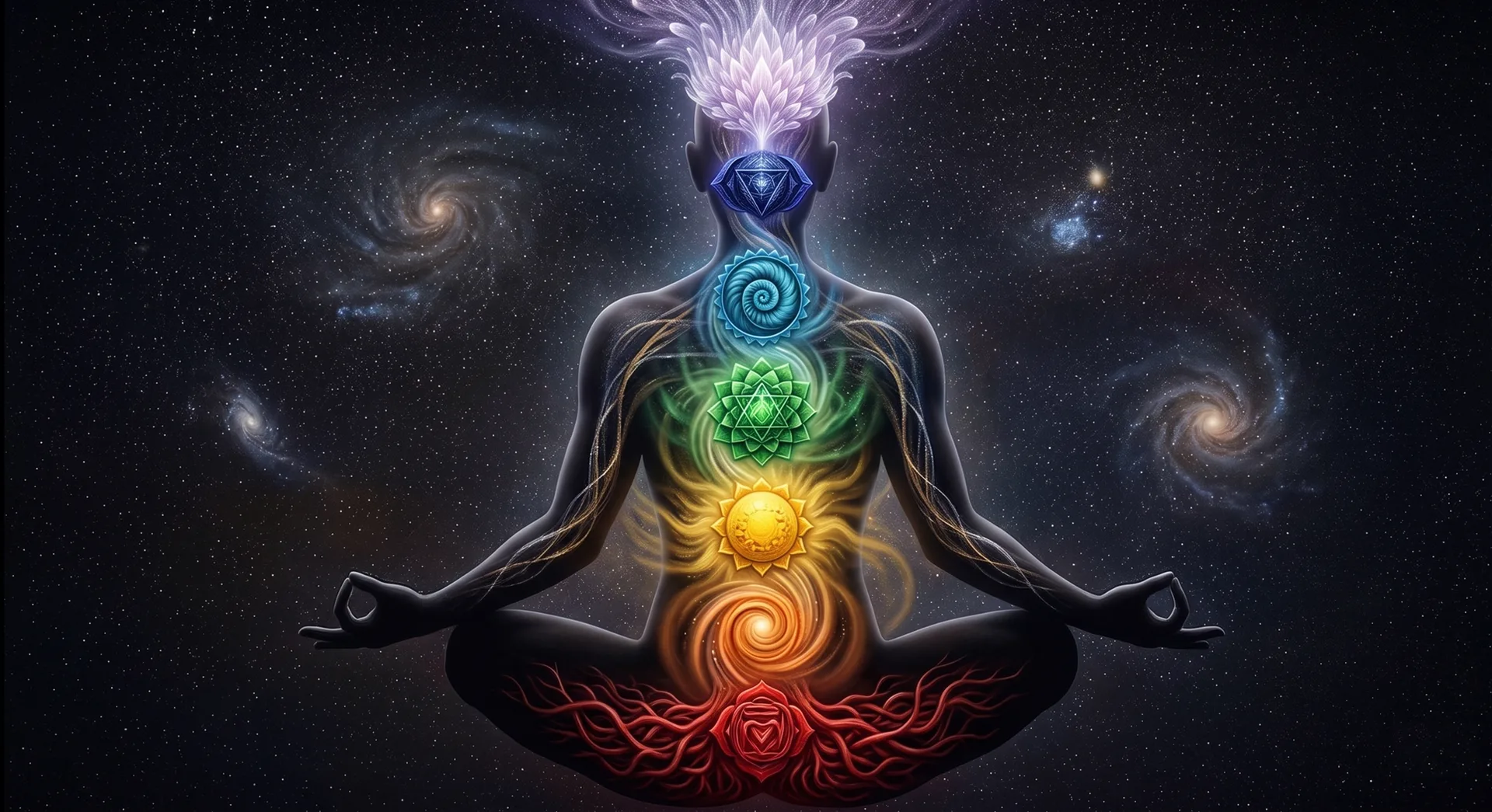
In the overall chakra system, Svadhisthana plays the role of an important bridge. It is located between Muladhara (the chakra of survival and basic needs) and Manipura (the chakra of social realization and will). If Muladhara provides stability, then Svadhisthana transforms this energy into emotional connections and creative impulses, which can then be realized in society through Manipura. An imbalance in Svadhisthana often leads either to emotional dependency (too much energy) or to creative stagnation and coldness in relationships (too little).
The results of chakra analysis allow for the selection of personalized practices for harmonization. For example, if the diagnosis shows a weak Svadhisthana, dance meditations, working with the color orange, keeping an emotional journal, or creative workshops may be recommended. If the chakra is overactive—balancing practices such as yoga for the pelvic area or breathing techniques to calm emotions. To learn your state, you can take a free chakra analysis, which will provide a starting point for your work.
Svadhisthana in CVD Diagnostics (Chronal-Vector Diagnostics)
CVD Diagnostics is an original method by Andrey Bukhtoyarov that analyzes personality by calculating the personality vector (stable character traits) and soul chronals (temporal development cycles) based on the date of birth. Unlike classical numerology, CVD considers a person dynamically, highlighting periods of activation of certain energies.
In the CVD system, the energy of Svadhisthana is read through several parameters. Temporal vectors show during which periods of life your emotional and creative needs are especially active—for example, during a "feelings vector" phase, you may be more open to relationships or artistic projects. Chronal codes reveal deep soul programs related to pleasure, creativity, and emotional intelligence. For example, a "creative realization" code may indicate an innate talent that needs to be unlocked through Svadhisthana.
In CVD, Svadhisthana is closely linked to the vectors of emotional realization (how you experience and express feelings), creative self-realization (how you bring ideas to life), and sensuality (how you perceive pleasure from the world). Specific qualities that CVD associates with this chakra include: emotional maturity (the ability to manage feelings without suppression), creative potential (the ability for non-standard solutions), capacity for pleasure (enjoying simple joys), and flexibility in relationships (adaptability in close connections).
CVD differs from classical chakra analysis in its more detailed temporal analysis. If chakra analysis gives a static picture of Svadhisthana's energy, CVD shows how it changes in different years or even months, helping to plan creative projects or relationships during favorable periods. CVD also focuses more on karmic tasks related to this chakra—for example, the need to learn the balance between giving and receiving in love.
Combined Application of Methods for Working with Svadhisthana
Combining numerology, the Matrix of Destiny, chakra analysis, and CVD creates a multidimensional map for working with the emotional and creative sphere. Each method adds its own perspective: numerology provides numerical keys, the Matrix of Destiny provides archetypal scenarios, chakra analysis provides the energetic status, and CVD provides temporal dynamics. Together, they allow not only to diagnose the state of Svadhisthana but also to build a holistic development strategy.
Here are some practical tips for comprehensive work:
- Start with diagnostics: first, complete basic calculations—chakra analysis for the general state of energy and a numerological calculation of numbers 2, 3, 6. This will provide an understanding of where the main strengths or blocks in your Svadhisthana lie.
- Look for intersections in the data: if, for example, in your Matrix of Destiny, the 6 The Lovers arcana is strong, and in chakra analysis, Svadhisthana is active, this may indicate potential for deep relationships. If at the same time the "creative vector" phase in CVD is weak, perhaps you need to pay more attention to self-realization, not just partnership.
- Interpret contradictions as growth zones: suppose numerology shows a strong number 3 (creativity), but chakra analysis reveals a block in Svadhisthana. This may mean you have an untapped creative gift hindered by emotional clamps. Working on your feelings will help release creative energy.
- Use the methods cyclically: apply CVD for planning—for example, launch creative projects during periods of Svadhisthana activation. Use chakra analysis and the Matrix of Destiny for deep work on patterns, such as fears in relationships or insecurity in your creativity.
This comprehensive approach turns working with Svadhisthana from a one-time practice into a conscious path toward emotional and creative harmony, where each method complements the others like pieces in the overall puzzle of your development.
Frequently Asked Questions
How to know if the Svadhisthana chakra is open?
Signs of an open sacral chakra: a stable feeling of joy, ease in creative self-expression, healthy sexuality without complexes, developed empathy, the ability to enjoy small things, and the capacity to build deep emotional connections.
Is Svadhisthana only related to sexuality?
No, sexuality is just one aspect. The Svadhisthana chakra also governs emotions, creativity, pleasure, relationships, and the ability to adapt to changes, much like water.
How does Svadhisthana influence creative abilities?
It is the source of creative energy: when the chakra is balanced, a person experiences inspiration, generates ideas, and easily implements them; a block leads to loss of interest, apathy, and creative stagnation.
What to do with suppressed emotions?
Use practices that release emotional blocks: Svadhisthana meditation, free-form dance, journaling (daily writing of feelings without judgment), contact with water.
Can you work with Svadhisthana after sexual trauma?
Yes, but carefully and preferably under the guidance of a therapist. Start with gentle practices: breathing techniques, color therapy, affirmations, gradually moving to more active methods.
How much time is needed to harmonize the chakra?
With regular daily practices (meditation, mantras, asanas), the first changes are felt within 2-3 weeks; stable balance is achieved in 21-40 days.
Conclusion
The Svadhisthana chakra is a dynamic center of creative and emotional energy that determines our ability to enjoy life, create, and build deep connections. Its imbalance often stems from childhood trauma or social prohibitions, but with the help of systematic practices—from meditations and mantras to dance and working with stones—a harmonious flow can be restored. Remember that opening the sacral chakra is a path to greater spontaneity, inspiration, and emotional freedom. To accurately determine the state of your energy centers, take a free chakra analysis on our portal—it will help create a personalized development program.